

Most YouTube creators test thumbnails once and call it done, missing the real power of iterative testing. The difference between a 3% and 8% click-through rate can mean thousands of additional views per video, yet many abandon testing after a single round or misinterpret early data. Strategic thumbnail testing combined with continuous iteration transforms channel performance by systematically identifying what resonates with your audience. This article breaks down YouTube's native testing tools, proven iteration frameworks, and design principles that maximize your testing results while avoiding common pitfalls that damage long-term channel health.
Table of Contents
- How YouTube Thumbnail Testing Works: Tools And Metrics
- Best Practices For Thumbnail Iteration And Continuous Improvement
- Common Pitfalls And Nuanced Strategies In Thumbnail Testing
- Design Principles To Support Effective Thumbnail Testing
- Optimize Your Thumbnails With AI Tools Today
- Frequently Asked Questions About Thumbnail Testing And Iteration
Key takeaways
| Point | Details |
|---|---|
| YouTube's Test & Compare | Upload up to 3 thumbnail variants and let YouTube rotate them evenly to gather reliable performance data over 7-14 days. |
| Data-driven iteration | Use winning thumbnails as new controls for continuous A/B testing, stacking improvements over time rather than stopping after one test. |
| Avoid common mistakes | Never stop tests early or use misleading thumbnails, as both damage watch time and long-term algorithmic recommendations. |
| Scale advantages | Large channels benefit from testing more variants and refreshing older video thumbnails to revive performance. |
How YouTube thumbnail testing works: tools and metrics
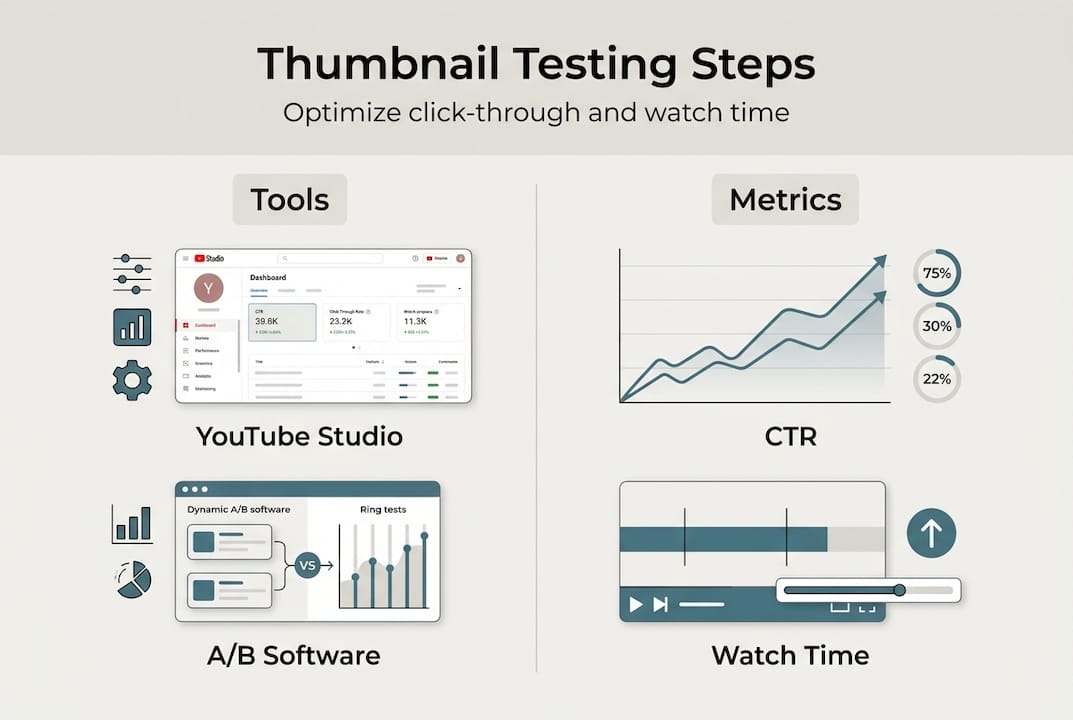
YouTube Studio's Test & Compare feature revolutionized how creators optimize thumbnails by providing a native solution that eliminates guesswork. You upload three thumbnail variants for a single video, and YouTube automatically rotates them evenly across your audience to gather unbiased performance data. This built-in system tracks critical metrics like click-through rate and watch time share, giving you concrete evidence about which visual approach drives better results.
The testing process requires patience and proper data collection. Tests typically run 7-14 days or accumulate 2,000-5,000 impressions per variant before reaching statistical significance. Rushing this timeline produces unreliable results that lead to poor decisions. YouTube's algorithm needs sufficient sample size to account for audience variation, time of day effects, and traffic source differences.
Tracking the right metrics separates effective testing from wasted effort. Focus on these key indicators:
- Click-through rate shows how compelling each thumbnail appears in search results and recommendations
- Watch time share reveals whether the thumbnail attracts viewers who actually engage with your content
- Impressions per variant confirm YouTube distributed traffic evenly across all test options
- Statistical significance indicators tell you when enough data exists to make confident choices
Many creators check YouTube thumbnail tips before launching tests, but understanding the mechanics ensures you interpret results correctly. The platform's even rotation prevents bias from traffic fluctuations or algorithm changes during the test period. When one variant clearly outperforms others across both CTR and watch time metrics, you have a statistically valid winner worth implementing permanently.
Best practices for thumbnail iteration and continuous improvement
Interpreting test data requires looking beyond surface-level click-through rates. A thumbnail might generate impressive CTR but tank your watch time if it sets false expectations. Always prioritize variants that improve both metrics simultaneously, as YouTube's recommendation algorithm rewards videos that keep viewers engaged. The winning thumbnail becomes your new control for the next testing round, creating a cycle of incremental improvements that compound over time.
Small channels face different optimization challenges than established creators. When you have limited traffic, excessive testing fragments your data and delays learning. After identifying a winning style through initial tests, maintain consistency to build brand recognition while your channel grows. Viewers start associating your thumbnail aesthetic with quality content, creating visual shortcuts that boost CTR organically.
Large channels unlock scale advantages that transform testing economics. Follow this iteration framework:
- Run initial three-variant test using YouTube's native tool to establish baseline performance
- Promote the winner to permanent thumbnail and design two new challengers testing specific elements
- Document what changed between variants to build institutional knowledge about audience preferences
- Cycle winning thumbnails back into testing against fresh concepts every 60-90 days
- Allocate budget proportional to video importance, with flagship content receiving premium design investment
The most successful creators like MrBeast invest $10,000 per thumbnail with extensive testing because they understand the return on investment. A 2% CTR improvement on a video receiving 10 million impressions generates 200,000 additional views. At typical RPM rates, that single optimization pays for itself many times over.

Refreshing older video thumbnails presents an underutilized growth opportunity. Videos from six months ago still generate impressions through search and suggested videos, but their thumbnails reflect outdated design thinking. Run new tests on your catalog's top performers to capture additional views from existing traffic. This strategy works particularly well for evergreen content that maintains steady search volume.
Pro Tip: Create a testing spreadsheet tracking every variant you test, including design elements changed, performance metrics, and insights gained. This database becomes invaluable for training new team members and avoiding repeated mistakes. Pattern recognition across dozens of tests reveals audience preferences that individual results might miss.
Consistency matters more than perfection when building channel identity. After testing confirms which visual elements resonate, incorporate those learnings into a creating YouTube thumbnails style guide. New videos should feel cohesive with your proven winners while leaving room for strategic experimentation on 20-30% of uploads.
Common pitfalls and nuanced strategies in thumbnail testing
Timing your tests incorrectly skews results and wastes opportunities. Avoid testing time-sensitive content like news commentary or trending topics, as audience interest shifts rapidly and corrupts your data. A thumbnail performing well on day two might fail on day eight simply because the underlying topic lost relevance. Save testing for evergreen content where viewer interest remains stable across the testing window.
Stopping tests prematurely ranks among the most expensive mistakes creators make. Early data fluctuates wildly as YouTube's algorithm explores which audiences respond to your content. The variant leading after 500 impressions frequently loses after 5,000 impressions once the system gathers representative samples across demographics and traffic sources. Data stabilization requires patience, but premature decisions based on noise rather than signal waste the entire testing investment.
Misleading thumbnails create a toxic cycle that damages channel health. You might see CTR spike when using sensationalized images or text that overpromises, but viewers clicking through quickly realize the content does not match expectations. Watch time plummets, negative engagement signals accumulate, and YouTube's algorithm reduces your video's reach. Short-term CTR gains never justify long-term recommendation penalties.
Most creators test thumbnails in isolation, missing the critical interaction between visual and text elements. Viewers process titles and thumbnails simultaneously when deciding whether to click. Testing combined title-thumbnail angles produces more actionable insights than isolated thumbnail tests. Frame your variants around distinct psychological triggers:
- Pain-focused angle highlighting a problem your video solves
- Curiosity-driven angle creating information gaps viewers want filled
- Goal-oriented angle promising specific outcomes or transformations
The gap between AI-generated and human-optimized thumbnails remains significant despite technological advances. AI thumbnails average 3.2% CTR compared to 8.7% for professionally designed options, reflecting the nuanced understanding of audience psychology that humans bring. Automated tools excel at generating quick variations for testing, but winning thumbnails typically require human refinement of composition, color psychology, and emotional resonance.
Edge cases require adjusted testing strategies. Seasonal content needs abbreviated testing windows to capture relevant traffic before interest wanes. Series content benefits from maintaining visual consistency across episodes while testing variations on the series template. Collaboration videos should test thumbnails featuring different creator combinations to identify which pairing drives strongest audience response.
"The biggest testing mistake is treating thumbnails as purely visual elements. Your thumbnail and title form a single persuasive unit, and testing them together reveals insights that isolated tests miss. Viewers decide in milliseconds whether your video delivers on the combined promise both elements make."
Advanced testing strategies separate growing channels from stagnant ones. Consider testing different thumbnails for different traffic sources if you have sufficient volume. Search traffic responds to different visual cues than suggested video traffic. Browse features favor bold, simple designs while search results reward informational clarity. Segmented testing requires significant scale but unlocks optimization opportunities that broad tests miss.
Revisit your expert thumbnail tips regularly as platform norms evolve. What worked in 2024 might underperform in 2026 as audience expectations shift and competition increases. Continuous learning prevents your testing strategy from ossifying around outdated assumptions.
Design principles to support effective thumbnail testing
Effective thumbnail design provides the foundation that makes testing worthwhile. Poor design executed perfectly through testing still underperforms good design with basic implementation. High contrast ratios of 7:1 minimum ensure your thumbnail remains readable across devices and lighting conditions. This technical specification matters more than aesthetic preferences because visibility determines whether viewers can even process your design.
Text readability makes or breaks thumbnail performance on mobile devices where most YouTube consumption occurs. Limit text to 0-12 characters using 3-6 words maximum in bold sans-serif fonts. Viewers scrolling on phones cannot read paragraph-length text, and cluttered thumbnails signal amateur production quality. Every word must justify its presence by adding critical context or emotional punch.
Emotional facial expressions activate viewer attention through innate human psychology. Our brains prioritize processing faces, particularly those displaying strong emotions like surprise, excitement, or concern. Close-cropped faces showing clear emotional states outperform distant shots or neutral expressions. The eyes should be visible and directed toward the camera or toward text elements you want viewers to notice.
Mobile optimization cannot be optional when 70% of YouTube watch time occurs on phones and tablets. Test every thumbnail candidate at approximately one-inch scale to simulate how it appears in mobile feeds. Details that look compelling on your desktop monitor disappear entirely on small screens. Simplify ruthlessly, enlarging key elements and removing anything that does not contribute to immediate visual impact.
| Design Factor | Optimal Range | Impact on Performance |
|---|---|---|
| Contrast Ratio | 7:1 minimum | Ensures visibility across all devices and lighting conditions |
| Text Length | 0-12 characters | Maintains readability on mobile screens where most viewing occurs |
| Facial Expression | Clear emotion visible | Activates attention through innate human face processing |
| Mobile Scale Test | 1-inch preview | Confirms design works at actual viewing size |
| Curiosity Gap | Moderate intrigue | Drives clicks without misleading viewers |
Curiosity gaps walk a fine line between compelling and misleading. Your thumbnail should raise questions that your video answers without making promises you cannot keep. Effective gaps highlight interesting aspects of your content rather than inventing drama. A thumbnail showing a surprising result with context removed works better than one depicting something completely unrelated to your actual video.
Color psychology influences viewer perception and click decisions. Warm colors like red, orange, and yellow grab attention in crowded feeds, while cool colors like blue and green communicate trust and professionalism. High-performing thumbnails often use complementary color schemes that create visual tension, making the thumbnail pop against YouTube's white or dark interface.
Pro Tip: Create thumbnail templates that lock in your proven design elements while leaving flexibility for video-specific customization. Templates ensure consistency across uploads while dramatically reducing production time. Your audience recognizes your content instantly, and you avoid reinventing the wheel for every video.
Typography choices communicate as much as the words themselves. Bold, thick fonts read better at small sizes than thin, elegant typefaces. Avoid script or decorative fonts that sacrifice legibility for style. Add stroke or shadow effects to separate text from background images, ensuring readability regardless of what appears behind the letters.
Composition principles from photography apply directly to thumbnail design. The rule of thirds creates balanced, visually interesting layouts. Leading lines direct viewer attention toward key elements. Negative space prevents claustrophobic designs that overwhelm rather than attract. Study high-performing thumbnails in your niche to identify compositional patterns worth testing.
Regularly reviewing thumbnail design tips keeps your skills sharp as design trends evolve. What separates adequate from exceptional thumbnails often comes down to subtle refinements in spacing, color balance, and visual hierarchy that only become apparent through deliberate study and practice.
Optimize your thumbnails with AI tools today
Testing and iteration require producing multiple thumbnail variants quickly without sacrificing quality. AI-powered tools streamline this process by generating professional options in seconds, letting you focus on strategic decisions rather than technical execution. The best AI thumbnail generator platforms combine speed with customization, producing test-ready variants that match your channel's style.
Expert-curated resources help you implement testing strategies effectively. YouTube thumbnail tips compiled from successful creators provide actionable frameworks you can apply immediately. Step-by-step guides for creating YouTube thumbnails walk through the entire process from concept to upload, ensuring you avoid common mistakes that waste testing opportunities. These resources transform theoretical knowledge into practical skills that improve your channel's performance.
Frequently asked questions about thumbnail testing and iteration
How long should a thumbnail test run before deciding a winner?
Run tests for 7-14 days or until each variant receives 2,000-5,000 impressions to ensure statistical significance. Stopping earlier produces unreliable results that lead to poor optimization decisions.
Can I test more than three thumbnail variants?
YouTube's native Test & Compare limits you to three variants per test, but you can run sequential tests using previous winners as controls. Third-party tools allow larger tests but require manual traffic splitting.
How important is design versus title in thumbnail testing?
Thumbnails and titles work together as a single persuasive unit, so test them as combined angles rather than isolated elements. Viewers process both simultaneously when deciding whether to click, making coordination between them critical for optimal performance.
Should I refresh thumbnails for older videos?
Yes, testing new thumbnails on older evergreen content captures additional views from ongoing search and suggested video traffic. Focus on videos still receiving steady impressions where improved CTR generates meaningful view increases.
What metrics besides CTR should I consider when testing?
Watch time share matters most because it reveals whether your thumbnail attracts engaged viewers rather than casual clickers. YouTube's algorithm rewards videos that retain attention, making watch time more valuable than raw CTR for long-term channel growth.